

Monk mode is all the rage in the self-improvement space.
It's about ruthlessly eliminating distractions, maintaining a rigid schedule, and even purposely declining social opportunities in pursuit of attaining a goal—losing 30 pounds of fat in three months, building an online business from your college dorm room, and everything in between.
Sounds like an effective way to reach your goals, right?
Sure. But there's a dark side to staying in monk mode for too long.
After spending three months in monk mode, I came face-to-face with that reality. It was not pretty.
Here's why you don't need to go monk mode to achieve your goals (and what you should do instead).
Monk mode in practice
Let's get clear on what monk mode is with an example.
Here was my routine for the past three months:
- Wake up between 5 and 6 AM
- Hydrate, get sunlight, and do breathwork
- Pre-workout meal
- Exercise (run, swim, or lift weights)
- Post-workout meal and take supplements
- Walk dog
- Work until lunch
- Lunch
- Walk dog
- Work until dinner
- Dinner
- Walk dog
- Take a cold shower and stretch
- Journal and read for an hour before bed
- Sleep at 8 PM
No watching videos while eating meals of course. No music or podcasts during dog walks either. That goes without saying. We're in monk mode!
Why did I follow this routine? Without a goal, this kind of rigid routine is meaningless.
It's because one of my goals for this year was to build a B2B SaaS with at least one customer. I even set it as the banner of my Notion dashboard, so I'd be forced to see it every day.
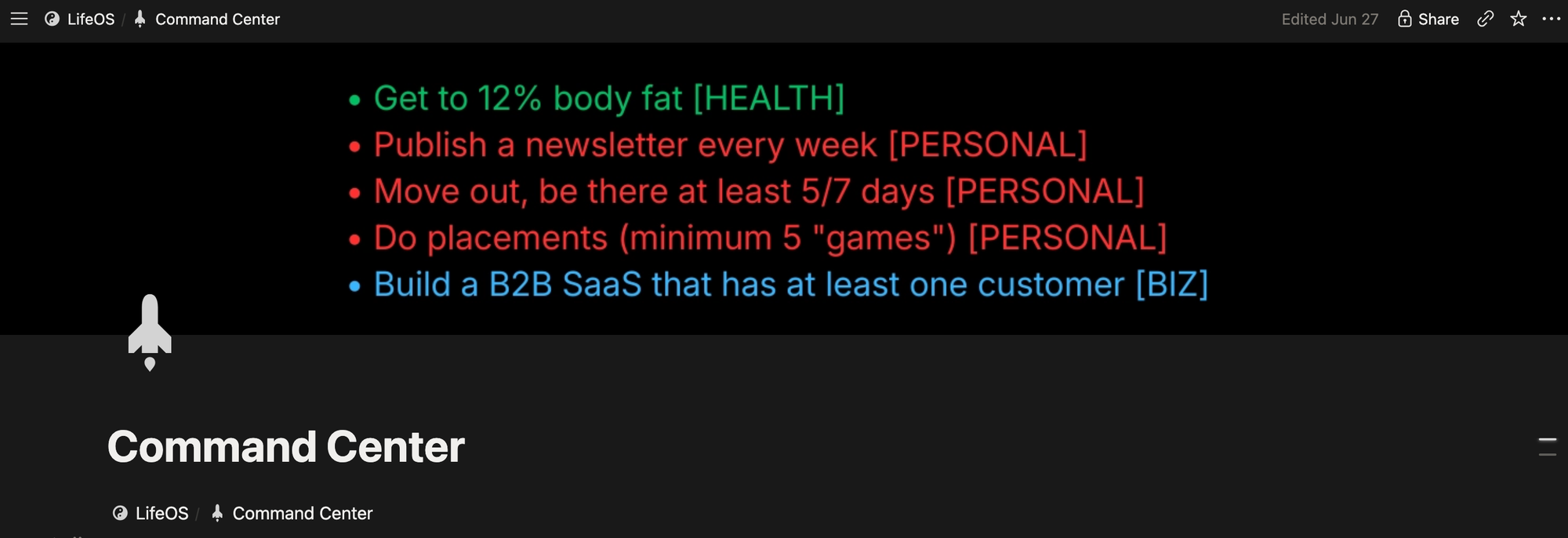
I knew it wasn't going to be an easy goal to achieve. With the advent of agentic coding tools like Claude Code and Codex, the number of SaaS products was going through the roof. There would be a lot of competition.
I'd have to be very consistent to get one customer. No way it was happening if I constantly went out at night, played video games, and generally just didn't show up to do the work.
Fortunately, my rigid routine paid off. I ended up checking that bullet point off of my goals checklist last month.
But that wasn't without paying a price.
Because unfortunately, I ended up sacrificing one of the most important parts of the human experience.
The price of staying locked in
I forgot how to have fun.
Full stop.
I forgot how to have fun.
In the past three months, I had plenty of opportunities to have fun. Organized events, gaming sessions, meals with friends, etc.
But whenever I sunk time into these, I always came out of it feeling guilty.
I'd think to myself afterward, "I could have been working."
I wasn't able to enjoy myself. Be fully present in the moment. Whether it was a dinner celebrating someone starting a new chapter in life or a short gaming session with friends—I found myself thinking about how much time I was wasting. How I could be back at my desk, being productive.
I think you get the point.
If you feel guilty for trying to have fun, relaxing, or just spending time with friends—you're literally forfeiting a significant portion of the human experience.
Enjoying the journey is a fundamental part of life.
Arguably, it's the entire point of life. After all, you're born, you experience a set of sensory stimuli, and then you die.
If you don't make something enjoyable out of that "set of sensory stimuli," did you really live?
The mountain will still be there tomorrow. But will you?
We all have different mountains we're trying to climb.
Some of us try to break records running ultramarathons. Some try to further the human frontier by developing bleeding edge technologies. Others fight to preserve the ecosystem, so the next generation can inherit a cleaner Earth.
All meaningful goals in their own right.
But no matter the mountain you're trying to climb, they all share one thing in common:
They will still be there tomorrow.
If you take a break from your training routine today, your running shoes will still be at the front door tomorrow. If you take a break from building your business, you'll still have needy clients hitting your inbox tomorrow. And if you skip a day of reigning in an invasive species of flying insect originating from northern China and Vietnam, they will still be buzzing around the trees in your backyard tomorrow.
My point is, the mountain doesn't just magically disappear the moment you stop working on it.
This is the antithesis to "there is no tomorrow."
While the phrase "there is no tomorrow" is a source of inspiration for those who procrastinate and never take a bet on themselves, "there's always tomorrow" is what needs to be fed to the hustle culture pushers, the workaholics, and the people who push until burnout. The people who stay in monk mode too long. The people who forget how to have fun.
To those people, I say:
Live a little. Life's too short not to.