


So you hopped aboard the "building in public" train.
Whatever you're doing—writing tweets, sending Substack newsletters, making YouTube videos, posting on LinkedIn, recording podcast episodes—you started because you wanted to show your work.
And as soon as you started, you noticed something.
Everyone else seems to be running the same play: a bold landing page, a free lead magnet, an email sequence drip, a 30-minute-long VSL. The whole direct-response marketing stack.
Should I be doing that, too?
No.
Unless your main source of revenue is selling info (courses, coaching, seminars, etc.), you should treat all that marketing stuff as a big, shiny object. It's going to feel very misaligned with your brand.
For everyone else, if you're thinking of creating a Russell-Brunson-style funnel for your content system, let me save you the hassle and show you what to do instead.
The funnel that never was
My last newsletter was a flop.
Actually, that's quite the overstatement. I don't even think you could call my last newsletter a proper newsletter.
Because I didn't write a single edition for it.
Let me explain.
In 2025, I launched my first business—a ghostwriting agency.
It started slow, but after pounding the pavement doing cold outreach for six months, I landed my first big client:
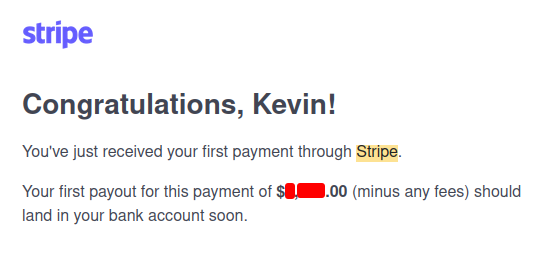
My jaw dropped when I saw that email from Stripe.
There's a comma in the number...
I felt like I had to share my process with the world. So I did something dumb.
I started a newsletter, wrote a 5-day email course explaining how I got to that first payout, created an entire n8n workflow to manage the drip sequence, gathered testimonials from an initial cohort of users, and then promptly abandoned the whole thing.
What happened? How could I have thrown away all that work so easily?
Simple. It was due to misalignment.
I went into that newsletter with the intention of creating a funnel. Not because I was genuinely interested in solving my audience's problems.
Here's the way I saw it:
My agency provided a service for people. Those people would pay for that service. That made me money. I'll teach people how to make money based on my own experience. That will get me more attention.
Even though I wasn't selling an info product for money (not that there's anything wrong with that), I wasn't passionate about my readers' problems—people trying to get their online agencies off the ground like me.
I just saw it as an opportunity to gain more status: followers, subscribers, etc.
I wasn't writing in any creative capacity. I was doing marketing for marketing's sake.
So by the time I finished writing that email course, I felt zero connection to that newsletter.
My problem wasn't ambition. It was sequence.
What to do instead
To become a philosopher king, start with being a king, not being a philosopher.
—Nassim Taleb
Too many people rush to play the wrong games.
Specifically, status games.
Winning status games gets you fame, like followers, impressions, engagements—all that viral goodness.
That's what I was chasing with the funnel sequence of my abandoned newsletter. Status.
But I'd argue it's much more useful to win wealth games.
Why?
- First, wealth is an indicator that you've created something useful for society. What's good for the hive is good for the bee.
- Second, wealth undeniably improves your quality of life. If you are rich and anonymous, you can do whatever you want with your time. You can't say the same thing if you're poor and famous.
- Third, it's easier to convert wealth to status if you really want it. Think about all those huge social media accounts that take roundabout ways to monetize: big accounts on 𝕏 offering repost services or Instagram influencers taking sponsorships from products they don't actually use.
Enter the arena of wealth creation first. Don't try to get famous right from the get-go.
That's the whole idea of the philosopher-king.
Although "philosopher" comes first in his title, he assumes that role last.
Instead, he starts by trying to become a king. What do kings do?
They accomplish epic stuff:
- building trade routes
- expanding their kingdoms
- leaving behind legacies that outlast them
But eventually, he grows old. He stops thinking about taking on ambitious ventures.
And so he retires his sword and starts transferring his knowledge to the next generation.
Sounds like the beautiful cycle of wisdom, right?
Now try to flip that.
You're 20 years old, telling everyone that you've achieved great things. And you pose as a sage to the "younger" generation? Some of whom are probably older than you?
Yeah, that one doesn't make sense.
To bring things full circle, ask yourself these questions before you spin up that funnel:
- Does the Internet need another guru?
- Have I gotten sufficient results to confidently show this to the world?
- Have I created sufficient value to society so that I can stop taking on new challenges and start passing down my wisdom to the up-and-comers?
I wish I had asked myself these questions before I went down that "teach the person behind you" rabbit hole.
If you feel misaligned trying to sell knowledge to the person behind you, it's because deep down, you know you haven't become a king yet.
Be hungry for knowledge when you're young. Learn from those ahead of you who are exiting the game.
Your time will come to be a philosopher. It's just not right now.