
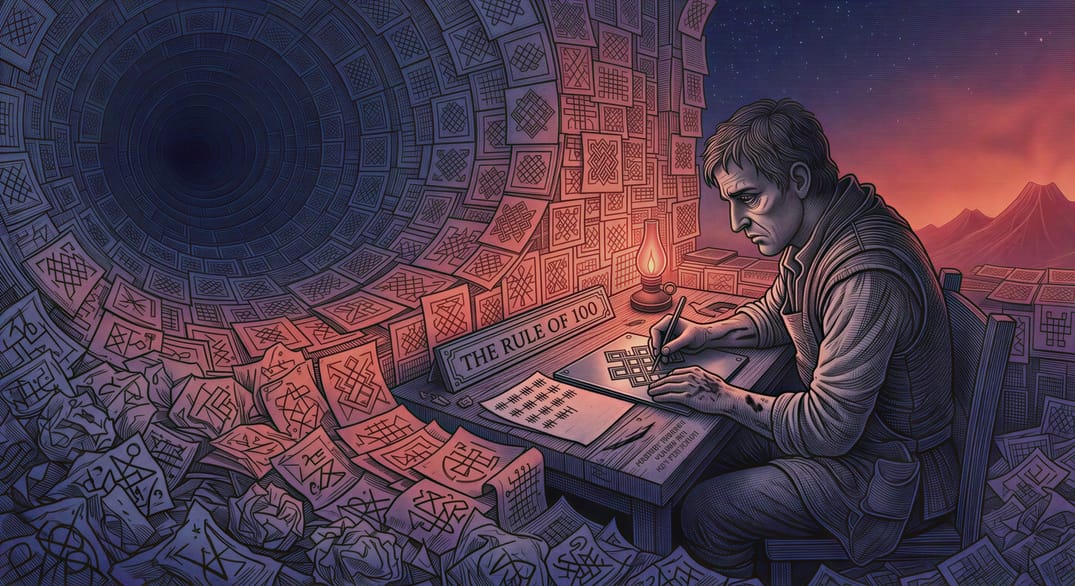

You want to get better at something.
Heck, you probably want to get better at a bunch of things. Why not, right?
Virtually any goal you're striving toward is locked behind improving yourself in some way.
I'd be lying if I said I'm 100% okay with where I am right now. I want better results. Bigger prizes. Outsized outcomes.
And I know you do, too.
After all, life would be pretty boring if you played the entire game on maintenance mode—never improving, staying stagnant, coasting in the comfort zone.
It sounds stupidly simple, but I always find myself asking the same question over and over:
"How do I get better?"
This letter is my answer to that question.
Volume is key
Quantity has a quality of its own.
—Napoleon Bonaparte
A pottery teacher splits his class into two groups:
- Group A is the "quality group." Each student is tasked with producing a single perfect pot.
- Group B is the "quantity group." Each student is tasked with producing as many pots as possible.
At the end of the semester, the pottery teacher inspects each group's work.
As soon as the teacher looks at Group A's pots, he notices flaws.
The designs are rudimentary. There are basic mistakes everywhere. Some of the pots are even chipped.
The same cannot be said for Group B.
Though the earlier iterations look somewhat barbaric, they quickly improve into elegant pieces of pottery.
As the teacher inspects the final pot of each student, he is stunned.
The craftsmanship is refined. The designs show real creativity. Some of the pots could sit in a gallery.
While Group A was focused on crafting one "perfect" pot—theorizing, planning, and overthinking—Group B was actually throwing clay around and learning from their mistakes in a rapid feedback loop.
Is it even a surprise that Group B produced the best work?
When in doubt, do more
Tweaking your business without data is a mistake.
When I say "tweaking," I'm not talking about being high on illicit stimulants (definitely no personal experience there). I'm talking about adjusting variables:
- Altering your company's logo and banner
- Swapping a word out for a synonym in your landing page headline
- Changing the onboarding email copy that gets sent out to all new clients
Okay, but why change these things? Why do we tweak things in our businesses?
We tweak because we think we have an imperfect system, and by adjusting it, we can make it perfect. Or closer to perfect.
When we doubt our results, we think:
"It must be because of some specific way I'm doing things right now. I should adjust things until the outcome improves."
I'm sorry to be the bearer of bad news, but...
This usually fails.
At least, when you don't have data to back up your adjustment.
I learned this the hard way in my last business, sending cold DMs.
When I first did cold outreach, I tweaked things like crazy, creating new message templates like there was no tomorrow.
I'd shift the personalization from the beginning of the message to the end, send a few DMs, then I'd add a straight pitch to show I was clearly selling something, send a few more DMs, and then I'd take that part out for a softer question to try and nurture the lead, and then send a few more DMs.
Did I get any valuable data from this process?
Nope.
For each message template, I just didn't send enough DMs to have confidence in the data.
If one template got double the response rate of another, that meant nothing to me. The sample size was too small.
As a result, I didn't gain much traction with my cold outreach. I would send dozens of messages a day to hear (mostly) crickets.
But then one day, I decided to stick to a single message template.
Mind you: I didn't stick to that message template forever. I just stuck with it for a large amount of volume. Enough that I could get some meaningful feedback to tell me if I truly needed to tweak something.
So I'd send a few hundred DMs, look at the data, adjust if necessary, and then do a few hundred more.
In this way, I was able to iterate and refine my template until I got to a 40% response rate.
I never would have gotten to that final iteration unless I did sufficient volume and listened to the data.
What I did was no different from the Group B pottery students:
Do the thing a bunch of times. Learn from the sheer volume you just did. Repeat.
Instead of blindly tweaking, adjusting, or trying to "perfect" your systems, you should just do more with what you currently have.
Volume creates data. And data removes drama.
If you want to get better at anything, the answer is simple:
Do more.