

It's Sunday. You're back on the content creation hamster wheel.
Whether you're batch writing 𝕏 posts for the week, editing today's Reel, or recording this week's YouTube video, you need one crucial thing:
Ideas.
The problem?
It seems like you never have enough of them.
Every week, you feel like you're about to get thrown out of the hamster wheel. Luckily, you're able to rack your brain for an idea at the very last second. You manage to hang on for another week. Just barely.
As someone who's been writing for over 10 years, I used to struggle with this all the time.
There'd always be a content deadline, and never enough ideas to meet it.
But then, something clicked.
I went from struggling to come up with content ideas to having more ideas than I knew what to do with.
It didn't happen overnight, so I can't promise you an instant solution.
But I can promise you a sustainable solution. And honestly? It's pretty effortless.
Let's dive in.
You don't need fancy frameworks
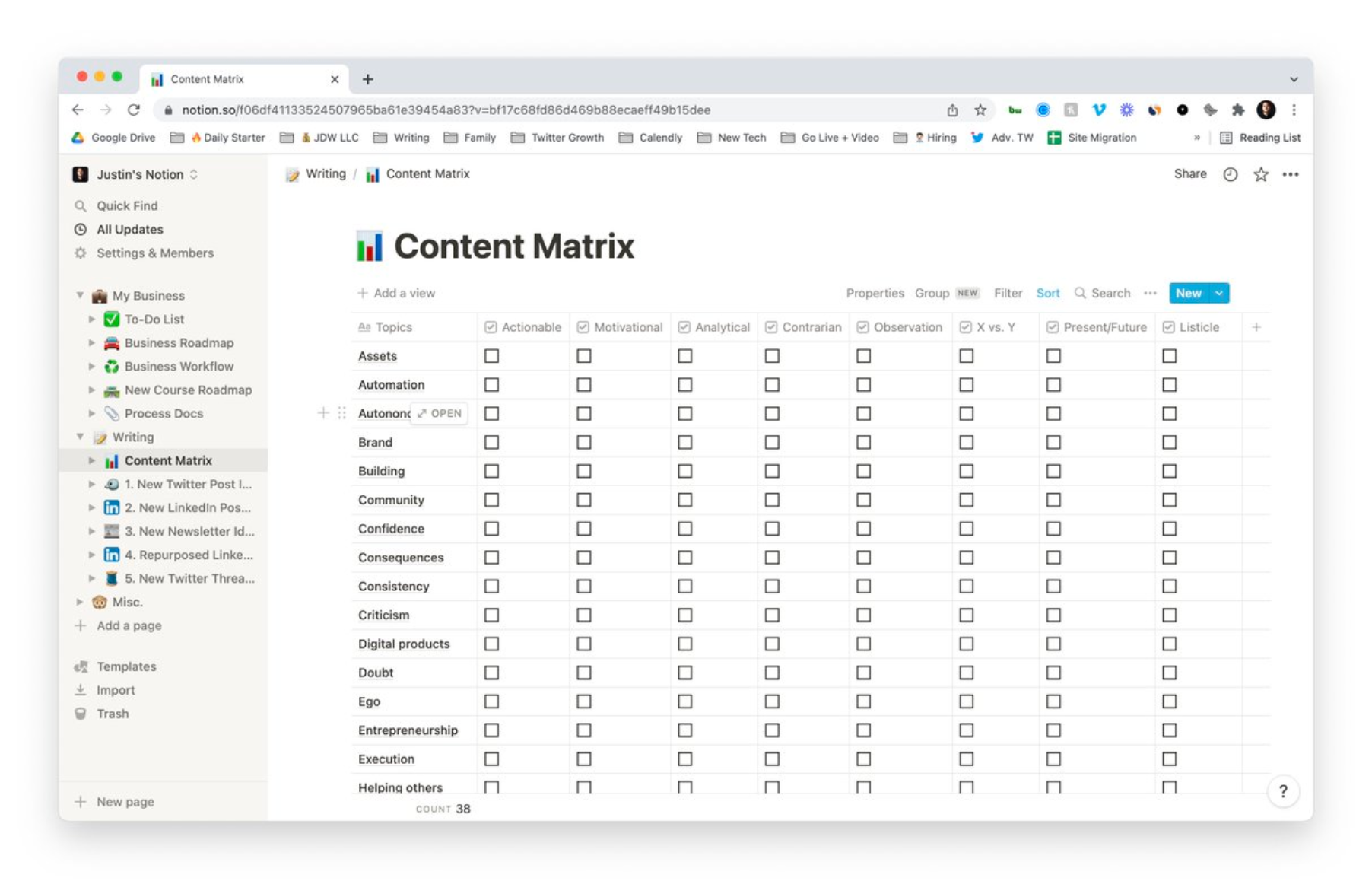
How does this image make you feel?
Anxious? Confused? Overwhelmed?
That's how I feel, at least.
You're looking at a content matrix, a system that helps you come up with content ideas by cross-hatching topics with lenses.
A topic is a broad domain you want to create content about:
- AI tools
- Entrepreneurship
- Personal branding
A lens is a frame through which you can discuss a topic:
- Analytical (cite statistics)
- Motivational (tell a story, tell your audience they can do it too)
- Actionable (give a concrete system, framework, or list of steps the audience can follow)
What's great about the content matrix is that you can start with a few topics and lenses and end up with many content ideas. It's multiplicative.
If you have ten topics you want to write LinkedIn posts about through ten different lenses, you have 100 distinct content ideas!
Woohoo! Right?
Yes and no.
Most content ideation frameworks (like the content matrix) are great for generating lots of ideas at once. The problem is that they all require a dedicated brainstorming session.
When I used these frameworks, I'd force myself to sit down with a notebook and draw matrices, mind maps, flow charts, and every trick in the book—even if I wasn't feeling creative.
I forced myself to come up with ideas when I wasn't feeling creative.
Unsurprisingly, most of my ideas were lackluster. And even though I'd be able to meet my content deadline—a newsletter for the week or three 𝕏 posts for the day—something was missing.
They weren't my best ideas.
Where your best ideas come from
If you've spent any time on the Internet, I'm sure you've come across r/Showerthoughts.
Here's the subreddit's own description:
A subreddit for sharing those miniature epiphanies that make the mundane more amazing.
And if you scroll for just a few seconds through r/Showerthoughts, you'll quickly realize just how many profound, thought-provoking ideas this community has collected.
To answer why this community has so many great ideas, look no further than the subreddit's name:
Shower thoughts.
A "shower thought" is a sudden idea that occurs to a person while they're doing a mundane task: washing the dishes, sitting on the toilet, or most aptly, taking a shower.
If I think about my best ideas, a surprising number of them came up while I was doing some boring, day-to-day task.
Why?
Or more precisely, where do your best ideas come from?
It's not the shower specifically. There's nothing creatively powerful about that acrylic tub and that hot water washing over you, per se.
No, your best ideas come from those little gaps in your day when you allow yourself to think.
When you're not blasting music through your headphones. When you're not doing productive work. When you're not mindlessly scrolling on your phone.
Instead, you have nothing but the present moment in front of you.
That's exactly where your best ideas come from.
Never run out of ideas again
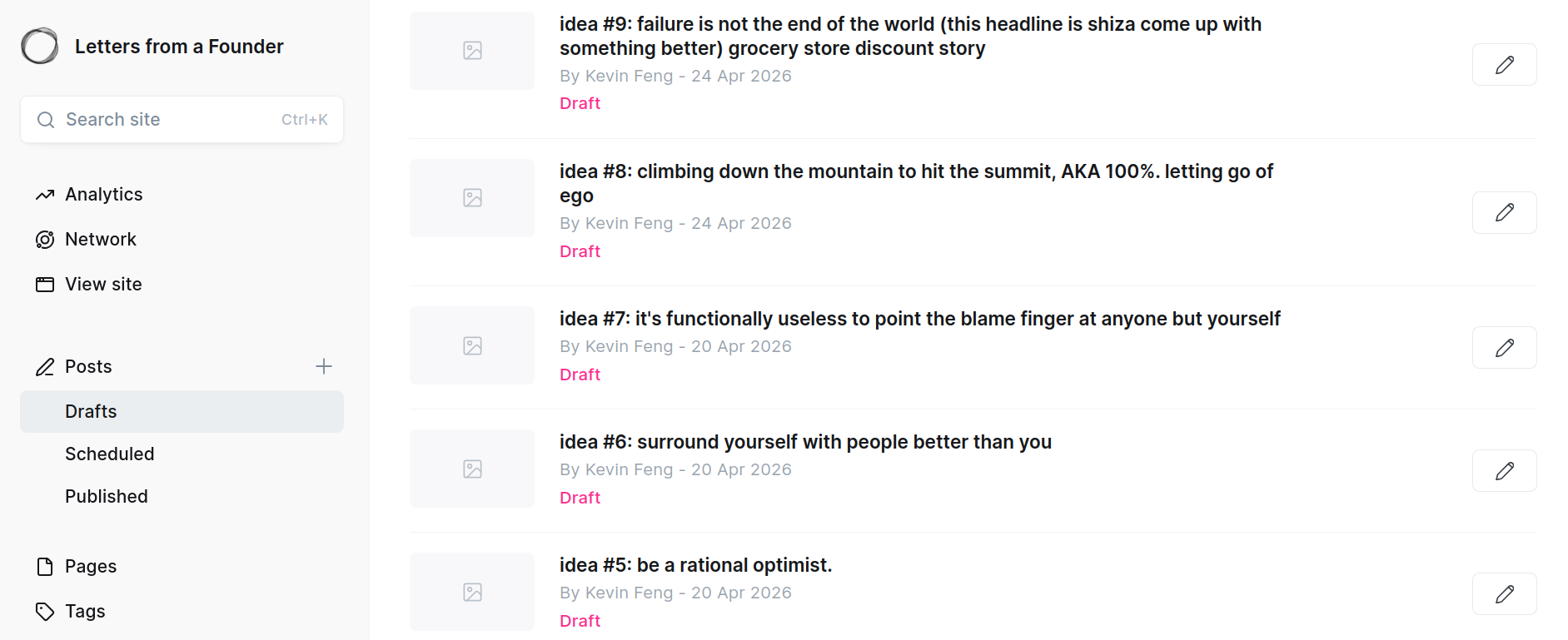
These are my newsletter drafts.
Actually, the screenshot is cut off. These are only some of my newsletter drafts.
Currently, I'm up to idea #18 in the queue. In other words, I'm covered for the next four months, assuming a weekly posting cadence.
How did I build up such a comfortable buffer?
Simple.
I started turning more of my day into shower thought moments.
Instead of watching a YouTube video during breakfast, I'd eat my food with no stimuli. I know, crazy :)
Instead of heading straight home after the gym, I'd sit in the sauna for 10 minutes.
And often, just before bed, I'd take a moment to do nothing. No scrolling, no journaling, no reading. I'd just sit in my rocking chair, staring into nothingness.
And slowly but surely, the ideas started flowing in.
Not every shower thought moment will net you a great idea, but if you intentionally create enough of those "pockets of nothingness" in your day, you'll be surprised at how quickly the best ideas start showing up.
The only thing left is capturing them when they arrive.
If I'm walking, I'll record a voice memo. If I only have my phone on me, I'll type in my Notes app. If I have my pocketbook on me, I'll jot it down.
Before you know it, you'll have more ideas than you know what to do with.