


Falling in love with your business idea is a mistake.
"But I thought I was supposed to follow my passion!"
Sure, go ahead. Follow your passion. Unfortunately, you're probably going to end up in an oversaturated market (or one that doesn't exist), creating a product that nobody wants, and ultimately be unable to pay your bills.
You'll be one of those "starving artists," so to speak.
Unlike the idea, the work is where 99% of your time and energy goes.
If you only enjoy the 10 seconds it took for that business idea to pop into your mind and hate the 10 years of trying to make it work that come afterward, you're not going to be very happy to say the least.
Here's why you shouldn't fall in love with your business idea (and what to do instead).
You might be stuck because you're in love
No, I'm not talking about you being in romantic love.
I'm talking about you being in love with your business idea... and making no progress on it.
Spending hours back-and-forthing with Claude to get it to generate the exact logo you have in mind, claiming you spent the last month doing "market research" to validate your idea, redesigning your social media banner so it has the perfect deep, philosophical quote that'll make everyone instantly follow your page—you know what I'm talking about:
Fake work.
It's all the stuff that doesn't actually move the needle.
Fake work is easy, makes you feel good, but doesn't actually help improve your product or distribution.
The real work is the stuff that you keep putting off. The stuff that you know you have to do if you want to see results. Cold emails, writing code, sending DMs, writing copy, following up with clients, the list goes on.
And it's when you're in love with your business idea that you don't do the real work.
You do the fake work because it's comfortable. Because there's no chance of failure. Because it's 100% safe.
When you love your business idea, you put it on a pedestal. You hold it at this absurdly elevated level in your mind. To the point that messing anything up with the idea becomes a nightmare.
So you don't take any chances to make that happen.
You don't do any of the real work, knowing that making a mistake might tear it off that pedestal for good.
Falling in love with the work
The only way to do great work is to love what you do.
—Steve Jobs
In 2005, Steve Jobs gave a commencement speech at Stanford University–now one of the most viewed commencement speeches in history.
In that speech, he stated that the only way to do great work is to "love what you do."
There's an important distinction to make here. Jobs does not advise us to "do what we love." Instead, he advises us to "love what we do."
What's the difference?
The first is akin to the stereotypical "follow your passion" advice that you hear all the time.
When you set out to do what you love, you don't take into consideration if you're targeting an underserved market, if you're disrupting an industry, or if you're creating a new method of value creation altogether.
No, you're just thinking, "What do I like? Let me go do that."
There's no consideration of how proficient you are at the thing or whether people will even pay you for doing the thing.
On the flip side, "love what you do" implies you're already in the "doing."
You're already doing the thing, but you just happen to fall in love with it as you go. And that's very different from pursuing your intrinsic interests.
In his speech, Jobs mentions that it can take a lifetime to find the thing that truly satisfies the conditions of "love what you do," but once you find it, you'll know for sure.
Of course, that leaves the final question:
How do you find that thing?
Finding your ikigai
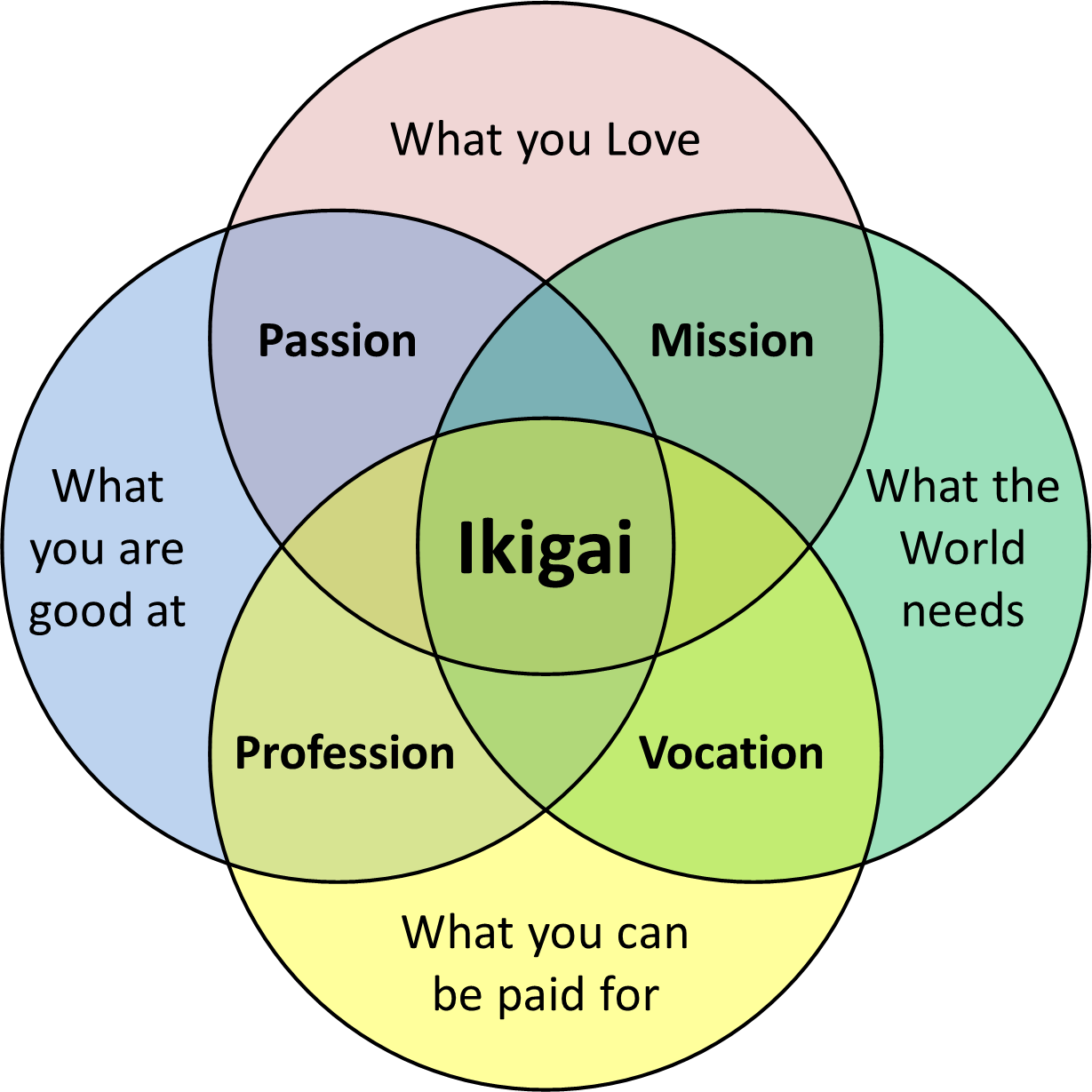
There is a term in Japanese called ikigai that defines an individual's meaning of their life.
Ikigai lives at the intersection of 4 domains:
- What you love
- What you are good at
- What the world needs
- What you can be paid for
If you love it, that means you enjoy it. This is the earlier "follow your passion" mistake that we discussed earlier. It's just one small part of finding your life's work.
If you are good at it, that means you have undeniable proficiency at the skill. You are likely much better at it than when you first started, and you are better than most other individuals at it.
If the world needs it, that means you're filling some kind of value gap. You're helping an underserved market, you're creating a new technology that will make peoples lives easier, etc.
And if you can be paid for it, well... that means you can make a living off of it. People will willingly hand over their economic momentum (cash, Bitcoin, whatever) in exchange for your thing.
The formula for finding your ikigai is simple:
Keep trying new things. Evaluate whether the thing you try fulfills all four domains. If it doesn't, move on.
And though it sounds simple, it's certainly not easy. Nor can I guarantee it will happen quickly. After all, I'm still looking for my ikigai myself.
Don't fall in love with your idea. Fall in love with the work. The idea gives you energy for a week. The work is what gives you energy for a lifetime.